
Required Reading for Anyone Trying to Understand Fascism is Not New to America
★★★★★ (Especially This Week)

By Ken Sheetz
I almost never review a book halfway through. But in honor of today’s surreal spectacle of macho chest-thumping, UFC birthday energy, and “America Rules the World” nostalgia, some historical clarity feels urgently needed.
I’m only halfway through Gangsters of Capitalism by Jonathan Katz and I already consider it one of the most remarkable historical accounts of American capitalism as empire I’ve ever read.
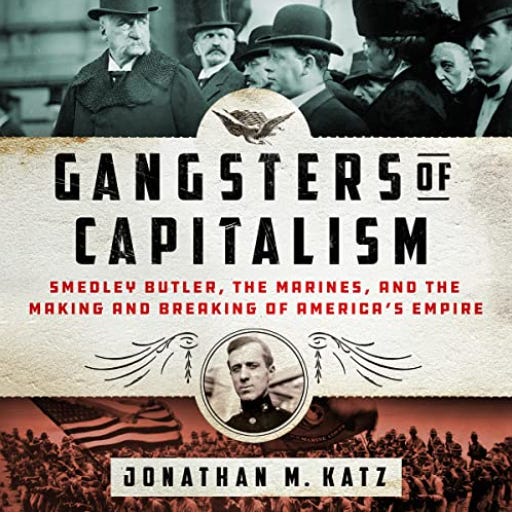
This is not dry history. It reads like a geopolitical detective story—following Marine General Smedley Butler through the machinery of American power while exposing how economics, military force, race, and corporate interests often moved together under the banner of “progress.”
What struck me most is how clearly the book connects the dots between America’s internal history and its global ambitions. The racism and dehumanization that fueled westward expansion after the Civil War and the brutal Indian Wars did not simply disappear after we stopped making Westerns where Indigenous people were conveniently cast as the villains. It evolved.
The same logic of supremacy, extraction, and “civilizing” others became part of the moral engine behind Manifest Destiny and later overseas intervention. Different lands. Different people. Weirdly familiar justifications.
The bitter pill of this book—and yes, you may want a stiff drink or at least a strong coffee to swallow it—is that America’s occasional flirtation with nationalism, racism, strongman swagger, and capitalist imperialism is not exactly breaking news. We didn’t invent the “we rule the world” flex last Tuesday. We’ve been workshopping versions of it for quite a while.
What makes this book so important today is that it challenges the comforting idea that Trumpism — especially on his cage match right our of IDIOCRACY 80th birthday is simply an aberration—some bizarre glitch in the American operating system. Instead, it suggests something more unsettling: that periods of racial resentment, concentrated wealth, militarized nationalism, and empire-building are recurring features in our story, periodically rebranded for a new century.
That doesn’t mean history is destiny. But it does mean understanding history matters.
And why am I confidently reviewing this halfway through? Because now I’m completely hooked by the story arc ahead: the transformation of a white Quaker war hero, Marine General Smedley Butler, into one of America’s fiercest anti-imperial voices. Watching someone from the very center of the machine begin to question the machine itself? That feels profoundly relevant right now.
Whether you agree with every conclusion or not, the reporting, historical connective tissue, and courage of this work are extraordinary.
I am genuinely excited to finish it—not because I think it will get easier, but because understanding how someone as deeply embedded in the machinery of power transformed into one of its fiercest critics feels profoundly relevant right now.
This should be required reading.
Five stars.
SOS is brought to you paywall free by our sister site CoolestTechEver.com.